
What is silver clay and how does it work?
Art Clay metal clay is easy to use, fun, inspiring and non-toxic. As a beginner you can use 'tools' you can find in your kitchen, office, or DIY toolbox. Art Clay looks and feels much like ordinary sculpting or porcelain clay.
What makes Art Clay so fantastic is that it consists of extremely fine particles of pure metal (silver or gold), almost like dust, mixed up with a non-toxic organic binder. The binder burns out during firing, leaving you with a pure metal piece.
Art Clay Silver has been around since 1995. Since its launch, there has been a few different types of Art Clay Silver, including Art Clay Original Formula, Art Clay 650, Art Clay Slow Tarnish, and Art Clay 650 Slow Dry. The latest version is Art Clay New Formula which has replaced the other versions of silver clay.
Art Clay comes in several different forms:
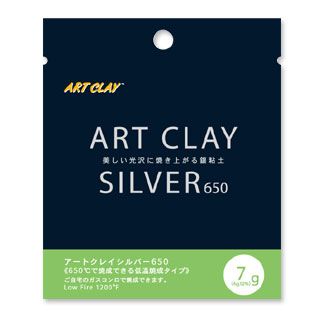
Aida has picked the best parts from their three most popular clays - easy molding from the Original, slow drying from the Slow Dry, and a low firing temperature from the 650 range. We think this might just be the ideal clay!
- It has a better workability and a longer working time than all previous Art Clay Silver products.
- It retains and accepts moisture easier than the existing silver clay types, which means it is easier to keep supple and much easier to reconstitute if it dries.
- It has similar drying times (when applying heat).
- It carves and files easier in the dry stage than the existing formulas.
- Fire with kiln, torch, or gas stove. Using a kiln the recommended time and temperatures are 30 minutes at 650°C on a continuum to only 5 minutes at 800°C.
- Shrinkage 8-9%.
- The clay can be hallmarked as fine silver at any UK Assay Office.
Art Clay Silver Paste  This thick cream-like paste version of the silver clay is made for repairs, like filling in cracks and 'glueing' broken pieces back together.
You also use it to stick unfired pieces together, so you can build up large dimensional shapes by making, drying, and finishing each piece individually - when they're all finished, you use the paste to stick them all together, which creates one solid piece after firing. It is a bit like a ceramic slip.
The paste can also be used to cover leaves, paper, cereals, and similar to make a fine silver replica.
If the paste is too thick, use a little water to thin it - only add a drop at a time, and stir slowly.
Art Clay Silver Syringe
 This softer version of the clay comes in a syringe to make fine lines, dots and other decorations. Its thicker than paste, and it also has a slightly different binder, which ensures it will hold its shape when extruded.
There are different sized tips (nozzles) to choose from, range from very thin so you can do very delicate drawings, medium sized which makes perfect little donuts which you can set stones in, up to thick which is perfect for building up thick lines - ideal if you want to make a piece from only syringe.
It can be applied to a core shape which burns off during firing, creating a filigree or lace-like hollow form. It is great for surrounding and setting stones in the clay, and it is ideal for repairs as you can be very precise with where you add the syringe line, using a fine tip. Shrinkage 8-9%.
Art Clay Silver - Overlay Paste
This is Art Clay Silver in a water based paste form, which has been especially designed to use on glazed porcelain, ceramic and glass. After firing (temperature ranging from 650°C to 800°C), it will bond to the surface and won't come off. Can also be used insted of normal Art Clay Silver Paste.
Art Clay Silver - Oil Paste
This oil based paste attaches to metal, so is used for repairing and fixing already fired pieces together, or for adding sterling or fine silver components to your silver clay pieces. It gives you a stronger bond than if you used the normal Paste. It comes with a thinning liquid to use if the paste dries up.
Art Clay Silver - Paper
The paper has a different consistency to the clays, it is completely dry and sliiiightly rubbery. It is thin and flexible, and can be plaited, origami folded, punched, cut, or layered to create thicker sheets. Cut out shapes with a craft paper punch and decorate your clay pieces. Applique pieces (where you put Art Clay paper on top of Art Clay clay) should ideally dry in room temperature or a low temperature dryer to avoid cracking. The paper on its own does not need to dry before firing, it can go straight in the kiln. Don't add any water to the paper. If you get any cracks, repair these after firing with the Oil Paste (adding water or normal paste will make the paper difficult to work with, and too much water will make it disintegrate). To apply paper shapes to a base clay piece, apply a small amount of thinned Art Clay Paste to the clay piece and apply the shape. Shrinks about 9-10% (as the shrinkage is higher than the clay, you can get some interesting doming effects if you add a lot of paper to clay).
Art Clay Gold 22 carat
This is the gold version of the clay, which can be worked just like the silver clay. Fires for 1 hour at 990°C. Shrinks 15%.
Art Clay Gold Paste and Accent Gold for Silver
These fantastic products are a economical and easy alternative to using the gold clay. It is simply pure gold in a liquid form, which you paint onto your fired piece, let dry, fire again, and burnish - and you have 22 or 24 carat gold accents! Super easy, and beautiful!
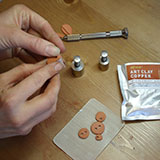 Petra's favourite base metal clay! A nice smooth clay to work with, with a gorgeous copper colour once fired. It is very easy to work with, but it comes out of the packet quite hard, and wants a little massage (wrapped up in cling film) before you use it to soften it a little. It does oxidise once open, so try to use the clay as soon as possible after opening. Vacuum wrapping is recommended. The nice thing with this clay is that it can be fired with a torch, so you don't need access to a kiln. Once fired you're left with 100% copper. Use separate (or very carefully cleaned!) tools as the copper can contaminate your silver clay. Shrinks about 10%.
HANDLING METAL CLAY
As all the clay forms contains water they will dry out if handled too much, for too long, under a hot lamp, in a warm climate, in a draft or placed on the wrong surface (use acrylic, glass, teflon, coated playing cards - something which won't act as a blotting paper or stick to the clay). See the Tools page for more information. If you feel you need longer to work with the clay, try Art Clay Silver Slow Dry, which will stay pliable for a lot longer than the other clay forms.
You can minimise the drying by making sure you are prepared, your tools are laid out, and you have an idea in mind before you unwrap the clay. Cut off a small piece only and put the rest of the clay back in the wrap. Keep a little piece of damp fabric or cling film which you can cover your clay with if you need to leave it for a short while.
Spread a little non-stick balm, Badger Balm, Slik, olive oil over your hands before you start - just a thin coat. This will stop the silver clay form sticking to your fingers and will also coat the clay which seals it a little from drying out. Don't use too much though, or your clay will be sliding all over the place. The best way to work with the clay is on a teflon coated baking paper. I often cover the clay with a clean sheet before using the roller.
Keep a little dish of water next to you, every now and then dip the tip of your finger (or use a small soft brush) and gently brush over the surface of your clay as you are working with it. This smooths out the surface, and helps to keep it pliable and moist. If you notice small cracks, it is definitely time to add a little moisture.
You can re-moisten dry metal clay with a drop or two of water, knead it in, wrap up carefully in cling film and put back in the resealable pouch. When you take it out a day later it should be as new. (I have noticed that some brands of cling film are better than others, so in case you have a very thin film, double it up)
-- Still dry? Well, add a little more water, knead and repeat the process.
-- If it is too wet, or a bit slimy, you have added too much water - dab the surface dry with fabric or kitchen paper (make sure it is good quality kitchen paper which won't leave your clay full of paper pieces), roll it up in your hand, knead it a bit, and then put it back on the shelf for another day.
The clay feels the nicest if it is used within a year of purchase, but it won't go off and doesn't really have a use-by date. Even hard clay can be re-moistened with a bit of work. Poke a lot of holes in it with a sharp tool and spray with water, the holes help the water to go into the clay. Wrap up carefully, keep adding water, poking holes and massaging it every now and then and soon it will be back to normal!
When you store your clay, add a little sheet of wet fabric or tissue in the pouch to keep the moisture sealed in.
Oh - one thing. Don't use aluminium tools or kitchen aluminium foil with the clay! The aluminium contaminates the clay and will cause loads of problems - some only noticable after firing.
DRYING
The finished piece needs to be completely dry before firing to avoid any damage. Air dry for a for a few hours/overnight in a warm spot (depending on size and thickness), or use a hotplate (food warming plate), hair dryer, dehydrator, kitchen oven set at a low temperature, or a heat gun to speed it up. Be careful when usingforced heat , if it gets too hot the binder might start burning off, and this can distort the shape. And, with a thick piece, the forced drying can dry the surface which will lock the moisture inside the clay. Drying the piece slowly in a warm environment with circulating air is definitely the best option if you have the time. Remember to also turn the piece to check that the back has dried.
When the clay is dry and leather hard, use files and abrasive sponges to adjust the shape and smooth the piece. Make sure that all little burrs or nicks are removed, remember they'll turn into metal when fired - not very comfortable. It is worth spending some time on finishing your piece prior to firing, as this will make an enormous difference to the finished look.
FIRING
You can use a kiln, gas hob, or a small handheld butane torch. The different types of clay have different requirements. A flat thin piece can easily be torch fired, while larger piece or shapes based on a core material should ideally be fired in a kiln.
Read more about the different firing options on the Firing information sheet.
NOTE - Sterling silver (925) contains copper (7.5%) which makes it a stronger metal than fine silver. Fine silver, or metal clay, has to be designed carefully if used for things which takes a lot of stress, like a clasp. If you make the piece sturdy it will work, but you might notice that there is a slight give in the material compared to sterling silver.
